
At the invitation of the municipality of The Hague, a 35 x 2.5 meter tapestry symbolizing the Netherlands’ history of slavery will be on display in the Atrium City Hall from May 6th to June 5th. The Netherlands officially apologized for its history of slavery in December 2022 and on July 1st. Throughout the nation, from July 1st, 2023, to July 1st, 2024, special attention was given to the theme of Dutch slavery. During the commemoration year, this deeply painful, important, and until recently underexposed aspect of our shared history was commemorated. In this context, Ricardo Burgzorg of the Villa Maecenatis Foundation developed a plan to create a monumental tapestry, designed by an artist or designer and produced by residents, in eleven provinces between 2024 and 2027. Each tapestry depicts the specific history of each province in relation to the history of slavery.
South Holland Wall Tapestry
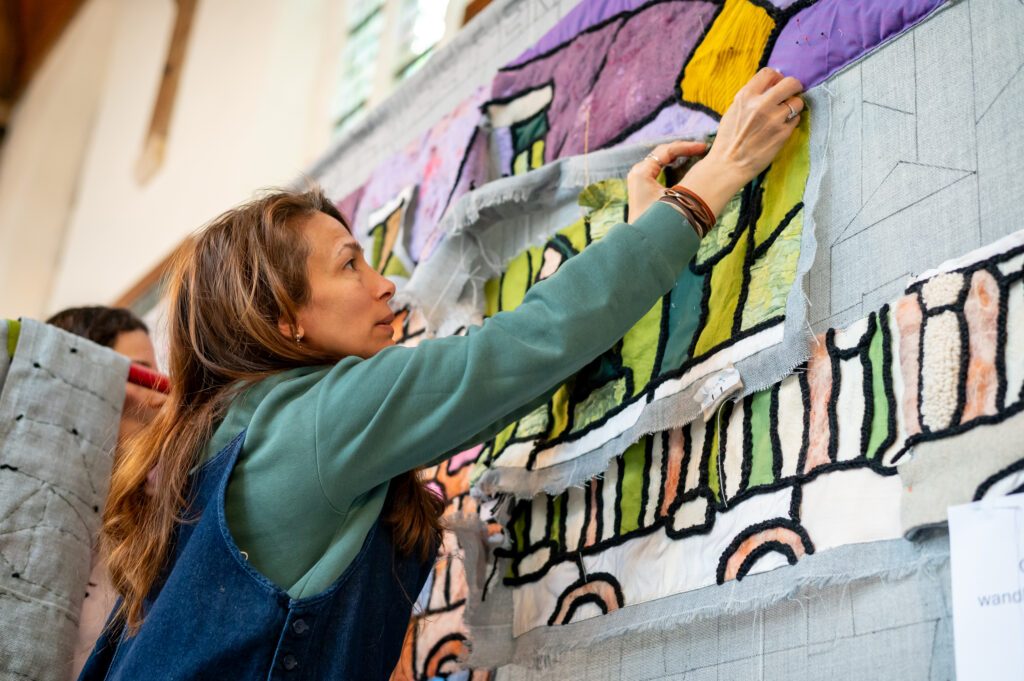
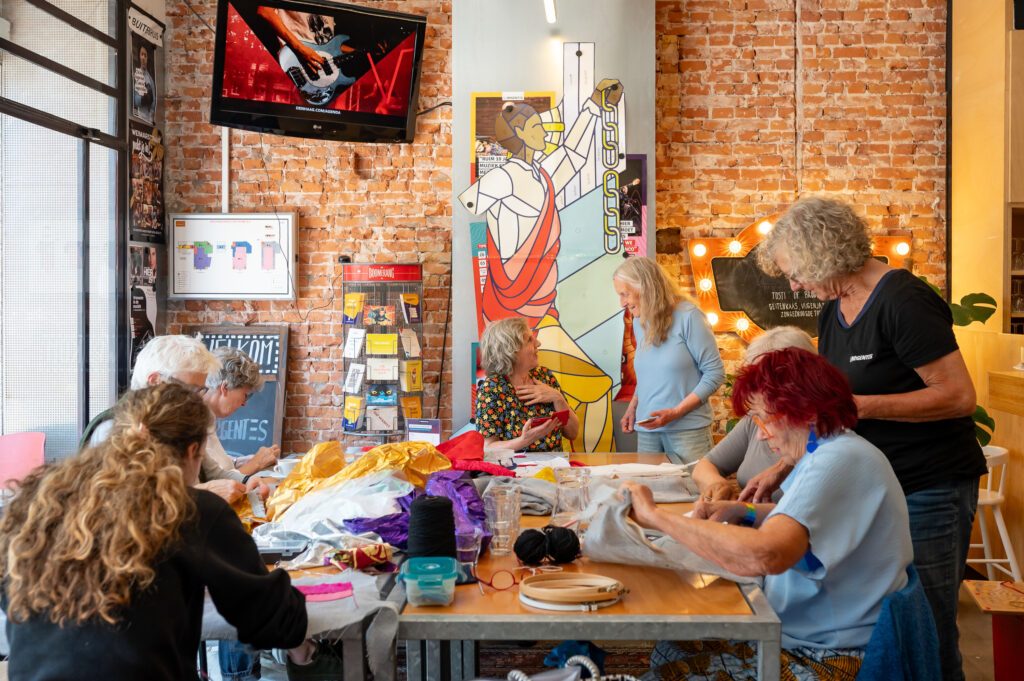
Starting in February 2025, workshops throughout South Holland collaborated on a unique, stained-glass-inspired monumental wall tapestry measuring 35 x 2.5 meters, designed by Marcos Kueh. Residents of the province of South Holland were invited to participate in the production of this tapestry. The production locations were in Delft, The Hague, Gouda, Leiden, Rotterdam, and Dordrecht.
Slavery History of South Holland
That South Holland played a major role in slavery is not a question, but a fact. The province played a significant role in the colonization of countries in the Atlantic region and the slave trade in many ways and at various levels. Indeed, the province of Holland even held a key European position regarding this trade and that of goods grown on the plantations in the colonies. Politically, the States of Holland also played a significant role, both in the Netherlands and abroad. For example, representatives of Holland were the most vocal advocates for financial support for the military actions against the slave revolts. They went to great lengths to defend the plantation colonies. For decades, educational institutions in Leiden and Delft trained colony administrators.
Provincial city administrators were involved in the establishment of the Dutch East India Company (VOC) and the Dutch West India Company (WIC). The Hague, via Delft, invested significantly in the WIC. Other cities also had connections with the colonies in various ways. Sometimes through trade and the establishment of plantations, but also through the processing of colonial goods, such as the sugar industry in Dordrecht or the cloth industry in Leiden. Colonial trade increased the status and prosperity of elite city dwellers, who used the profits from the plantations to build large country houses and gardens and invest their money in various collections. Provincial museums are often indebted to this and, in recent years, have also conducted research into their history and the provenance of objects in light of the history of slavery.
After the abolition of slavery in 1863, slave owners received financial compensation. Moreover, slavery in Suriname was followed by the organization of mass migration and forced labor of indentured migrants from Asia. This was accompanied by racial prejudice and an economic interest that trumped human well-being.
Design by Marcos Kueh
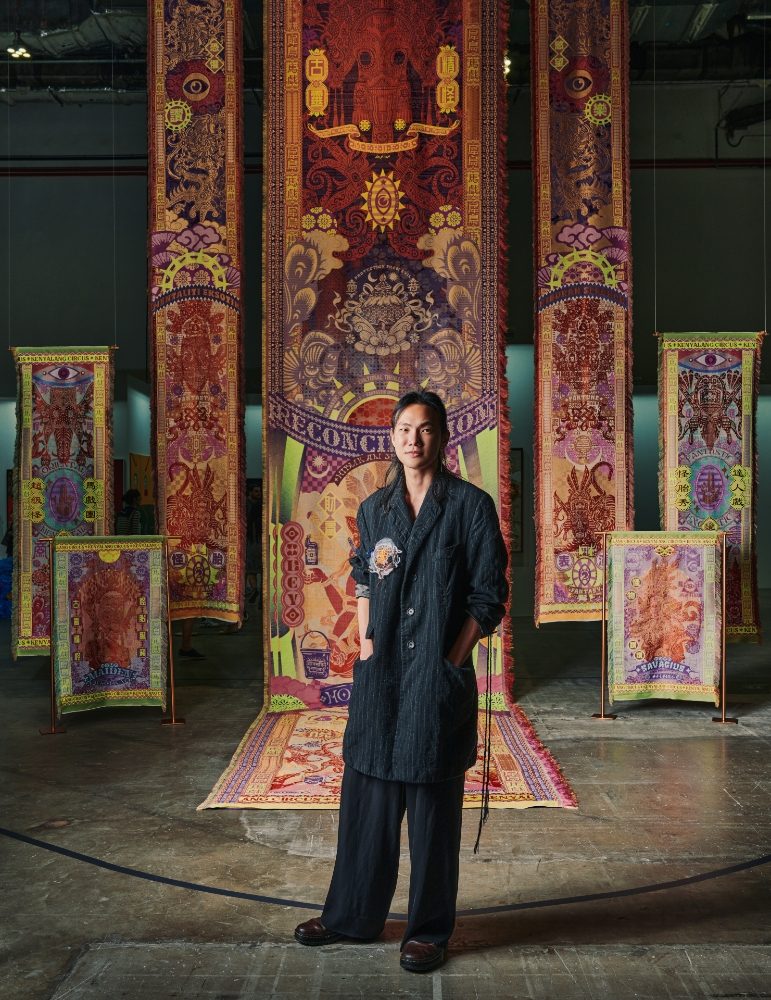
Marcos Kueh (Sarawak, 1995) is a textile artist with a background in graphic design and advertising. His practice primarily revolves around using textiles as a means to visualize everyday stories he finds meaningful—much as Borneo’s ancestors did with their dreams and legends, before the arrival of written alphabets from the West. In many of his artistic research projects, he explores the spectacle of how his country is perceived—from colonial descriptions in anthropological museums around the world, to marketing texts in tourism advertisements, to his own experiences as a small-town person in Borneo. These perspectives form the fundamental worldview of how he participates in and contributes to discussions.
Marcos Kueh drew inspiration for the visual language of the South Holland tapestry from stained-glass windows in churches. Christianity is the religion most closely associated with Western colonial expansion.
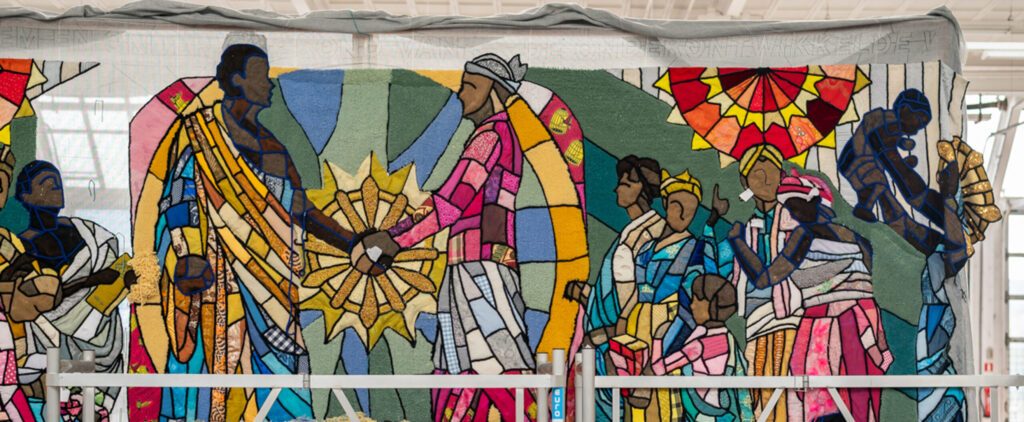
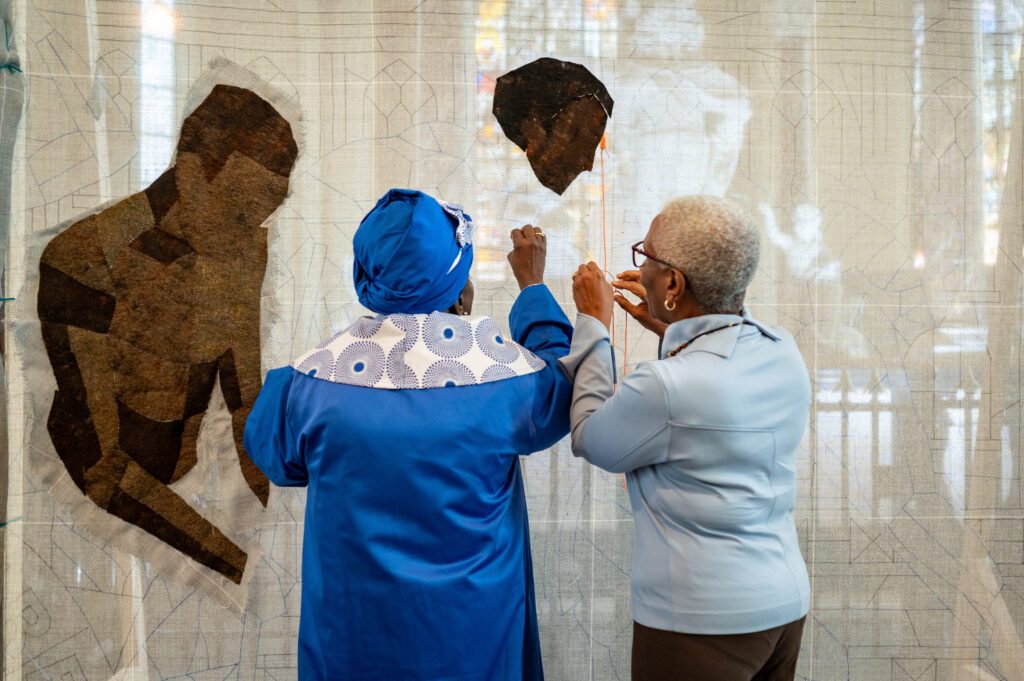
The story of this tapestry begins on the sides with the history of slavery and ends in the center with hopes and dreams for the future. On the far left is the image “Tribute to the Colonies,” similar to the one found on the Golden Coach. This depicts the ideologies of the past that brought injustice and inequality to both the Caribbean and the Dutch East Indies. Leiden University and the Mauritshuis are also depicted. These institutions symbolize changing knowledge and understanding of the history of slavery. The enslaved Africans depicted on the left side of the tapestry represent the abuse of human labor during the colonial era.
On the right side of the tapestry, enslaved people from Southeast Asia are depicted carrying goods to a Dutch ship, such as those used by the Dutch East India Company and the Dutch West India Company (in full, the Chartered West India Company) to exploit the colonies. Also depicted are the East India House in Delft and the VOC harbor in Rotterdam, buildings that symbolize the often ill-gotten wealth that underpinned the Netherlands’ historical, violently acquired prosperity.
Both groups of enslaved people move toward the center of the tapestry. They are framed by the symbols of Keti Koti, the day Suriname commemorates the abolition of slavery in 1863. The center of the tapestry parodies the image on the other side of the Golden Coach. Instead of Lady Holland in the center, two enslaved people are depicted here shaking hands in a gesture of equality. Surrounding them are the descendants of enslaved people, enjoying their free time instead of serving or suffering inequality.
At the top and bottom of the tapestry is a quotation from The Wretched of the Earth by the French-Martinican psychiatrist and philosopher Frantz Fanon (1925-1961), one of the first to publish on the psychological consequences of colonialism for both perpetrators and victims. The quotation is an indictment of European prosperity, which was achieved “on the backs of enslaved people.”
Realization of the tapestry
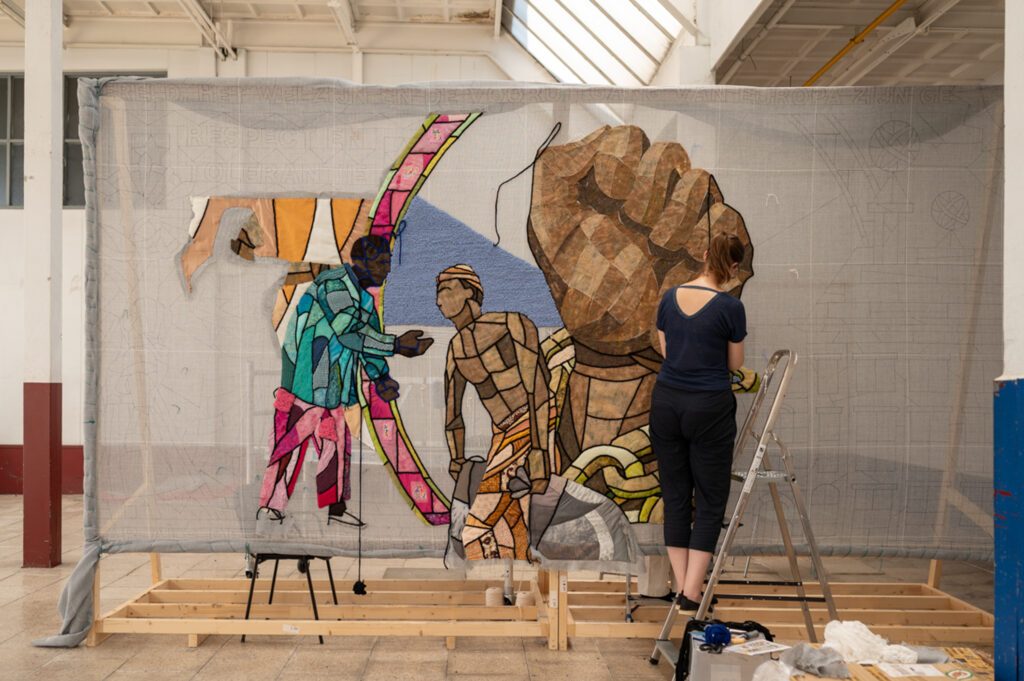
Textile artist Caroline Grootenboer transformed Marcos Kueh’s design into the tapestry it is today. Caroline has years of experience as an artist, specializing in textile techniques, which are reflected in her artworks, “Changeable Art.”
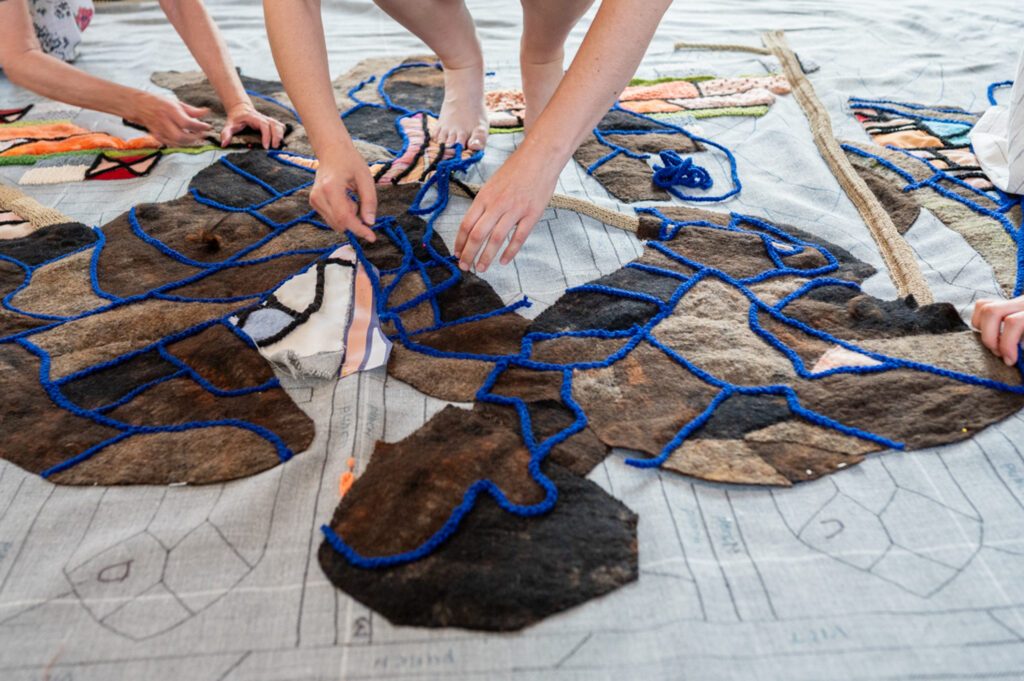
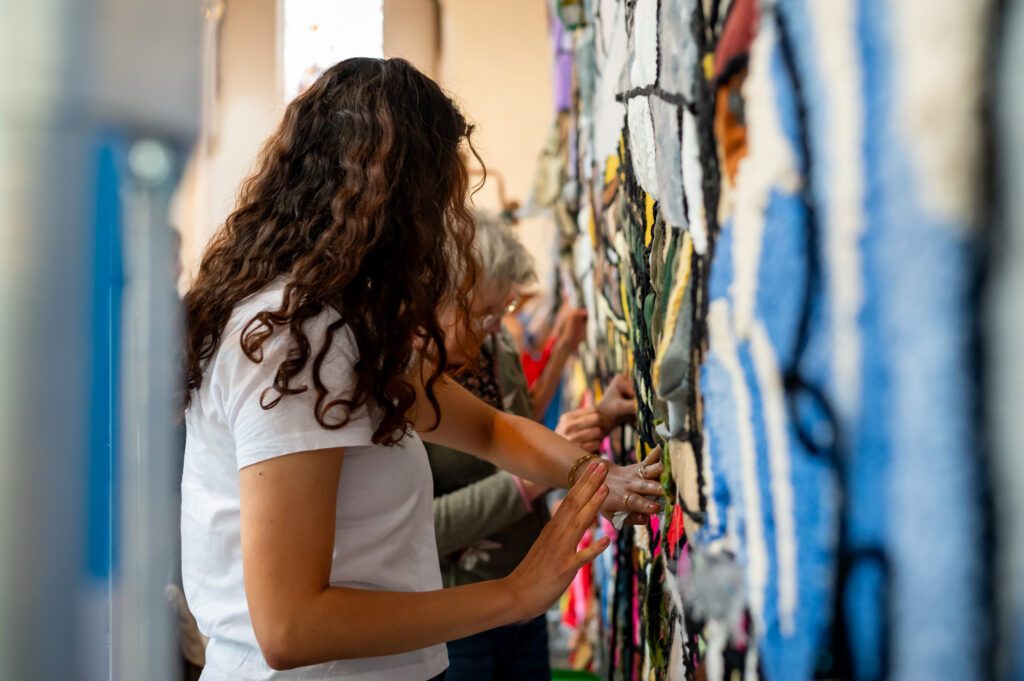
Caroline Grootenboer guided the tapestry’s creation both substantively and practically. Under her inspiring leadership, 600 volunteers—mostly women, with varying degrees of experience—worked on the tapestry in various locations. It was therefore crucial that Caroline knew how to share her knowledge and experience with others.
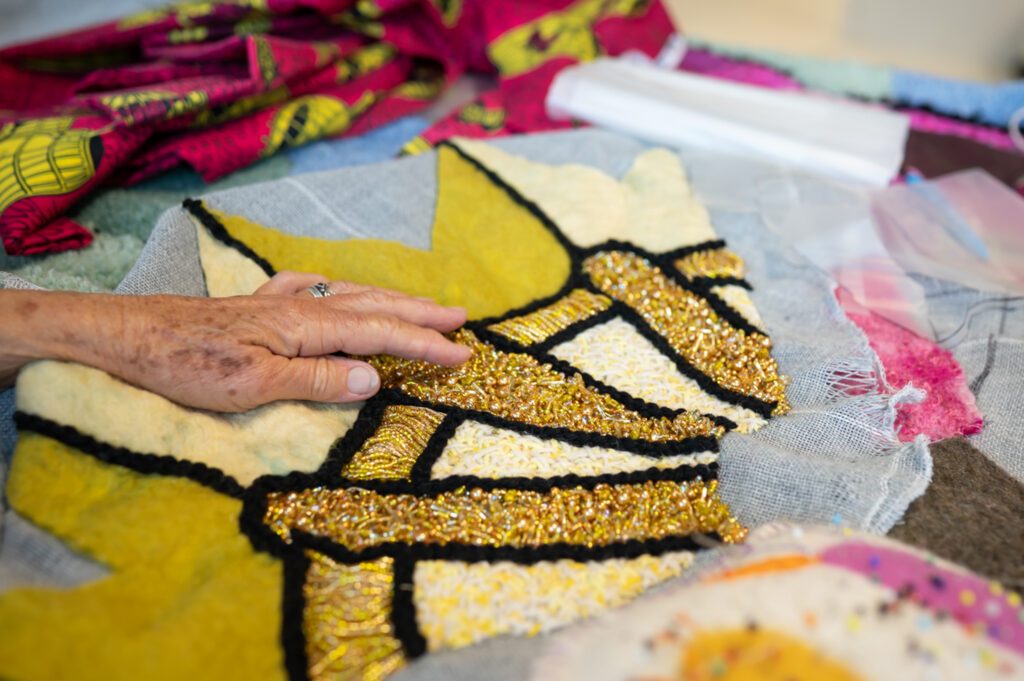
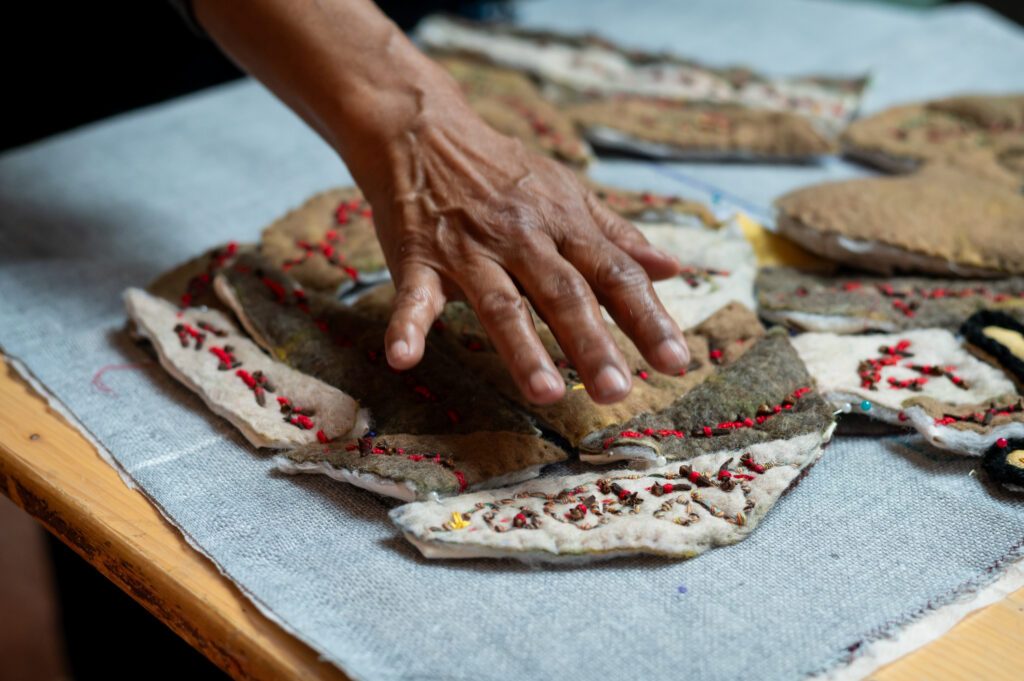
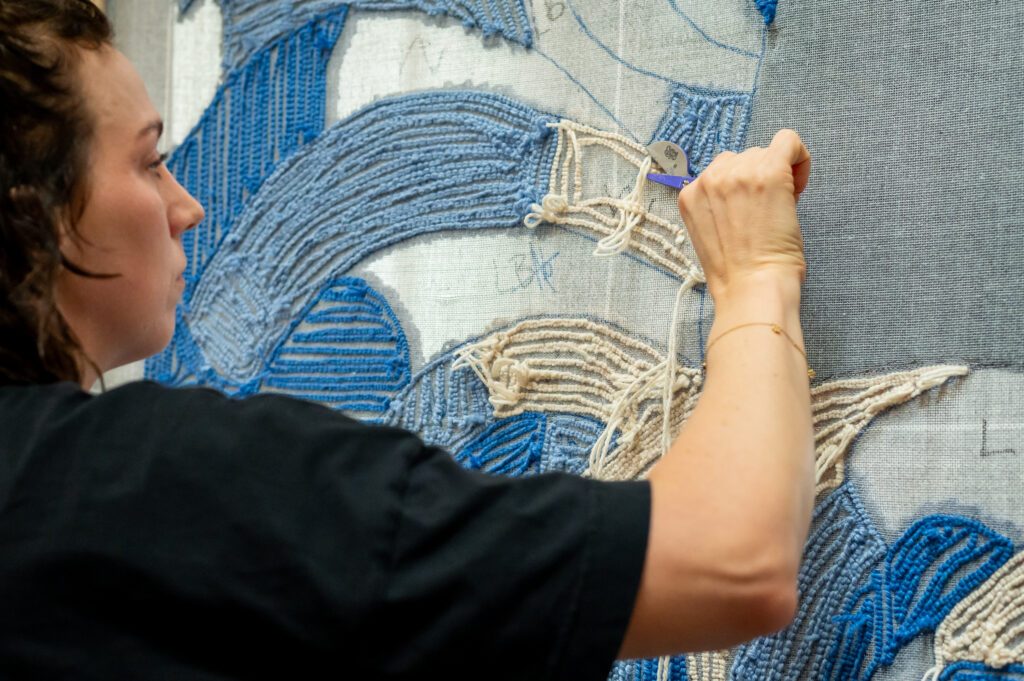
Marcos Kueh’s design offered a great opportunity for this, as it consists of many small sections. Caroline laid out the general outline, but within that outline, the volunteers were given considerable freedom to fill in the sections themselves. Several regular supervisors were able to use Caroline’s plan to guide large groups of volunteers to create their own sections of the tapestry. This also allowed them to gain knowledge of the techniques used in the tapestry: felting, quilting, embroidery, punching, and tufting.
The volunteers also brought their own experiences with textile techniques, as well as their unique stories. For example, a woman, a descendant of the Banda Islands, incorporated her own design into the first part of the tapestry. She found the process healing. Fabrics and colors from her ancestors were also passed on and incorporated. The tapestry thus consists of layered structures, and the individual interpretation gives the story an even deeper emotional meaning. This is palpable in the tapestry. Those who come to view the tapestry not only gain intellectual understanding of this dark chapter in our history, but also experience it with their own eyes.
Monumental tapestry added to the Kunstmuseum Den Haag collection
“It is an honor that this work will be displayed, preserved, and cared for in the Kunstmuseum’s collection. The tapestry serves as a place of convergence: of details, symbolism, and diverse textile techniques, but above all, of the many who made it together. This collective creation and sharing of meaning is what we, as a museum, want to cherish and pass on.” – Margriet Schavemaker, General Director of the Kunstmuseum Den Haag
Made possible by
Afimo, Bibliotheek Den Haag, Bibliotheek Gouda, Canidream, Comité 30 juni – 1 juli Den Haag, Comité 30 juni – 1 juli Leiden, Cultureel Educatief Centrum Dordrecht, DelftsPeil, De Nieuwe Regentes, Dijkxhoorn Bouwgroep, Erfgoedhuis Zuid-Holland, Grote of Sint Laurenskerk, Kunstmuseum Den Haag, Museum De Lakenhal, Museum Prinsenhof Delft, NEST, Oude en Nieuwe Kerk Delft, PEP Den Haag, ROC Mondriaan, Stichting Gedeeld Verleden Gezamenlijke Toekomst, Stichting Grote of Sint-Jacobskerk, Stroom Den Haag, Universiteit Leiden, Urban Chicks With Brains, Wereldmuseum Leiden.
Funds
Fonds 1818, Fonds 21, Fonds voor Cultuurparticipatie, Gemeente Den Haag, Gemeente Delft, Het Cultuurfonds, VSBfonds, VriendenLoterij Fonds
The Threads of Our Dutch Slavery Past project is organized by the Villa Maecenatis Foundation and is an initiative of Ricardo Burgzorg.
For more information, visit dvons.nl.


Application form
Thank you for your interest in organising your activity in the Atrium City Hall!Click on the Application Form button below and fill in your application. Applications will only be processed within a forthnight by completing the form below with as much as possible information about your activity.
Application form